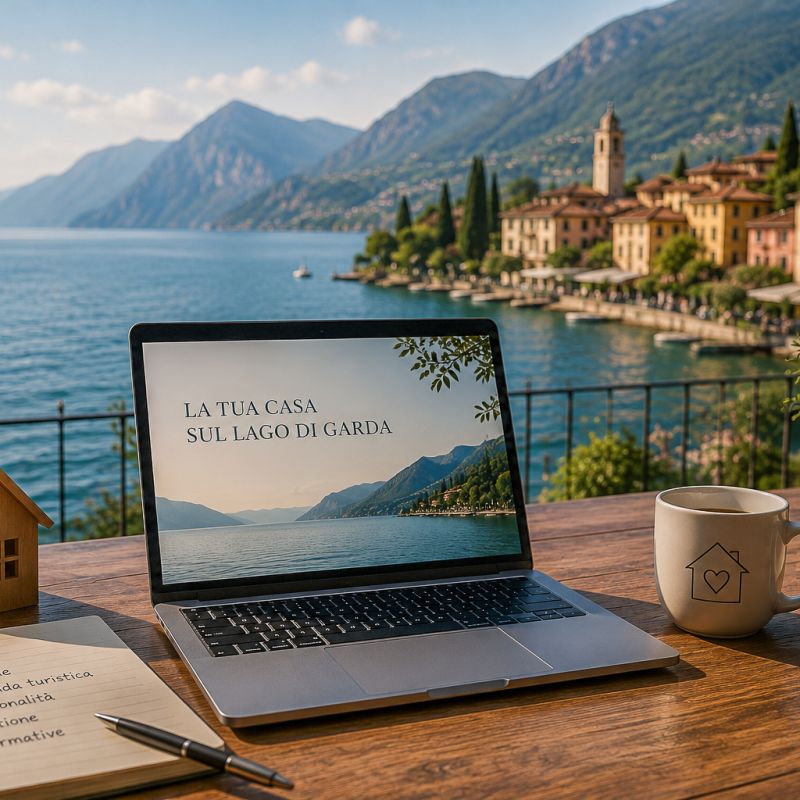
Buying a Home on Lake Garda for Vacation Rentals: What You Need to Know Before You Start
Buying a Home on Lake Garda for Vacation Rentals: What You Need to Know Before You Start
Buying a property on Lake Garda and using it, at least partly, for vacation rentals is an option that interests many property owners. The area’s strong appeal as a tourist destination makes it possible to use a second home as a source of income when it is not being used personally.
Before considering this option, however, it is important to understand that renting a property to tourists involves much more than simply publishing a listing on a booking platform. There are several aspects to consider, starting with the characteristics of the property and the type of demand it is likely to attract.
Location is naturally the first factor. A property close to the lake and town centre, easily accessible and with private parking can appeal to a different type of guest than a property located further away. Similarly, a swimming pool, terrace, garden, lake view, number of sleeping places and the overall quality of the property can have a significant impact on the rate it can achieve and on its appeal to tourists.
For this reason, vacation rental rates on Lake Garda can vary considerably. There is no single average rate that can be applied indiscriminately to every apartment or house. Market data can nevertheless help give an idea of the scale of the sector.
According to the Lighthouse monitoring system used by the Verona Garda Tourist Observatory, between 29 May and 21 June 2025, coinciding with several important German public holidays, the average occupancy rate of apartments offered as short-term rentals on the Veneto side of Lake Garda was 54%, with occupancy exceeding 60% on some days. During the same period, the ADR (Average Daily Rate, meaning the average daily rental rate) was approximately €225 per night on the Veronese shore. The ADR refers to the accommodation rate and therefore does not represent the property owner’s net income.
The summer season can reach even higher levels. According to the Observatory’s 2025 data, considering the short-term rental sector monitored on the Veneto side of Lake Garda, average occupancy from January to October was 45%, while during the summer months it exceeded 60%. This figure refers to a sample of more than 10,000 properties and should not be considered representative of every individual property.
These figures highlight an important point: a rate of €200 or €300 per night cannot simply be multiplied by every day of the season. Occupancy varies throughout the year and also depends on the property’s characteristics, its location, demand and the period being considered.
For anyone considering buying a second home with the intention of also using it for vacation rentals, it is therefore important to distinguish between rental rates, occupancy and actual income. These factors must also be considered alongside management costs, cleaning, maintenance, possible booking platform fees and the time required to manage the property and assist guests.
There is also another, less visible but essential aspect: the legal and administrative requirements. In Veneto, tourist rentals are subject to a specific regional notification procedure as well as requirements concerning the collection and transmission of statistical data. At national level, properties used for tourist or short-term rentals are also subject to the obligation to obtain a CIN (Codice Identificativo Nazionale – National Identification Code) through the national database of accommodation facilities. The CIN must be included in listings and displayed in accordance with the applicable regulations. The CIN does not replace the regional requirements applicable to tourist rentals.
These are only some of the aspects that need to be considered and do not replace a specific assessment of the property and the requirements applicable to each individual case. Before purchasing a property with the intention of using it for vacation rentals, it is therefore also advisable to check its planning and building status, as well as any condominium rules that may apply.
For this reason, when considering a property on Lake Garda for this purpose, the question should not simply be: “How much can I charge per night?”
A more useful question is:
“How suitable is this property for the vacation rental market?”
A sought-after location, good amenities, outdoor spaces, parking, a swimming pool or a lake view can help position a property in a different market segment. However, even a highly attractive property needs to be assessed in terms of seasonality, occupancy, management and costs.
Vacation rentals can therefore represent an interesting opportunity for those who own or are considering buying a property on Lake Garda. But potential income is only one part of the overall picture. Before buying, it is important to understand not only how much a property could earn, but above all whether it is suited to the type of tourist demand in the area and what managing it over time actually involves.